Background
On July 14, 2026, the U.S. Senate unanimously passed S. 2120, the Older Americans Act (OAA) Reauthorization Act.
Because the previous authorization expired in September 2024 (and a nearly finalized 2024 bipartisan bill stalled late that year due to broader budget gridlock), this is the most significant progress the OAA has seen in years. The bipartisan bill, led by Senate Aging Committee Chairman Rick Scott (R-FL) and Ranking Member Kirsten Gillibrand (D-NY), with Senate HELP Committee Chairman Bill Cassidy (R-LA) and Ranking Member Bernie Sanders (I-VT) also joining the reintroduction, now heads to the House of Representatives.
What’s Different: 2026 Reauthorization vs. 2020 Reauthorization
Based on the 2026 bill text (S. 2120), here’s what appears to be new or meaningfully expanded compared to the 2020 Reauthorization:
1. A Longer Timeline and a Steady Funding Ramp
- The 2020 Version: Authorized OAA programs through FY 2024.
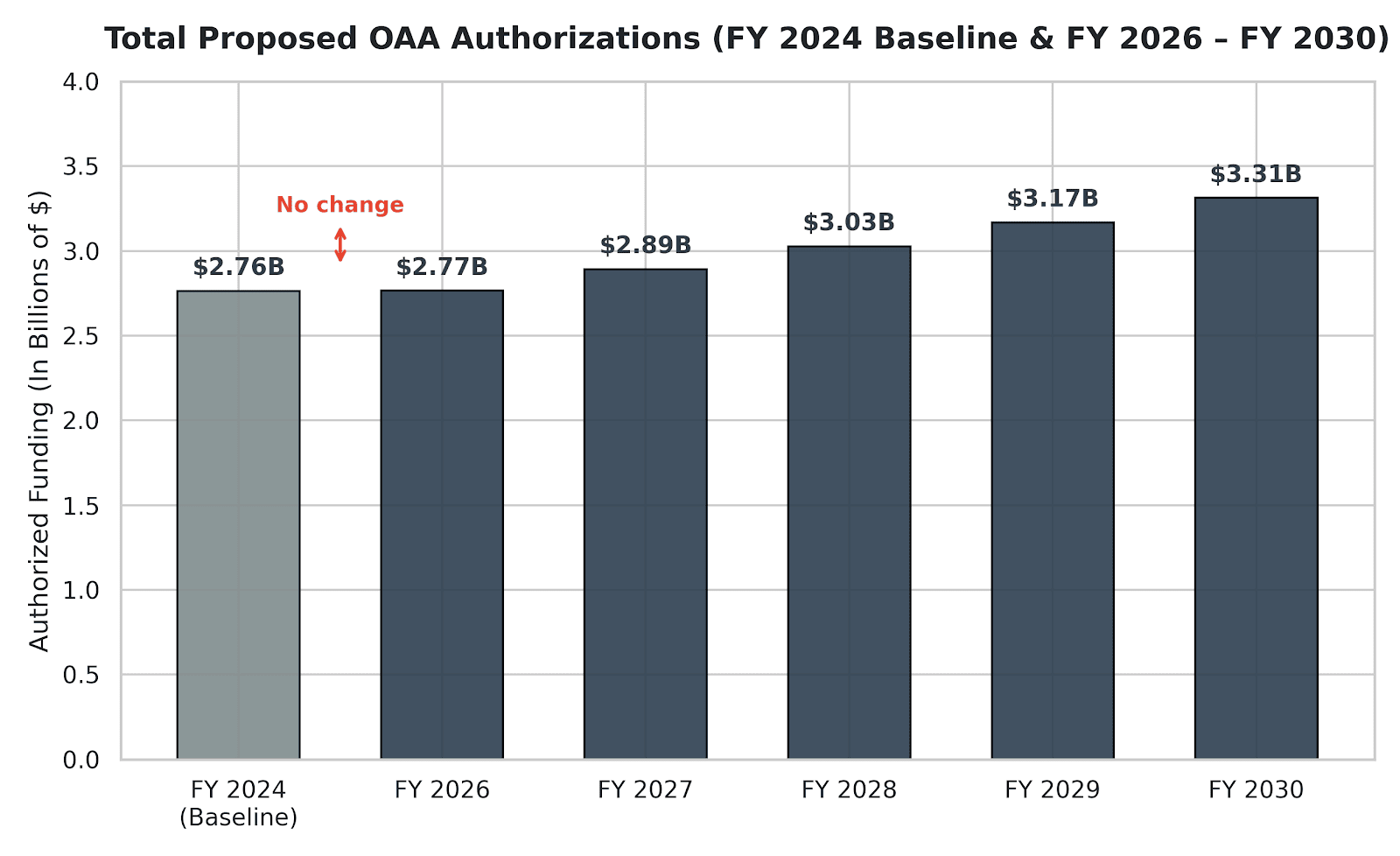
- The 2026 Version: Extends program authorizations through FY 2030. Applies a uniform 4.62% compound annual increase to every line item across the entire Act starting in FY 2027 (meaning FY 2026 funding is flat-funded to match the FY 2024 baseline), creating a steady, predictable funding ramp that results in an approximate 20% cumulative budget increase by FY 2030 over the baseline.
2. Permanently Codifying “Grab-and-Go” Congregate Meals (Sec. 302)
- The 2020 Version: Only funded traditional, site-based congregate meal programs; any pandemic-era carryout or pickup flexibility was temporary and depended on emergency federal waivers rather than the OAA itself.
- The 2026 Version: Permanently authorizes states to use congregate nutrition grant funds for carryout or “grab-and-go” meals at community locations, providing a permanent statutory footing for local hybrid service models that programs built during the pandemic.
3. Upgrading the Direct Care Workforce from Demonstrations to a Permanent Center
- The 2020 Version: Limited workforce support to temporary, proof-of-concept grants and contract authorities designed to demonstrate new strategies for recruiting and retaining direct care staff.
- The 2026 Version: Formally codifies a permanent National Resource Center to Support the Growth of the Direct Care Workforce, meaningfully expanding the center’s mission to provide standing infrastructure, training, and support specifically for unpaid family caregivers alongside professional workers.
4. Strengthening National Oversight of the Long-Term Care Ombudsman Program (LTCOP)
- The 2020 Version: Focused on state-level standards by updating guidelines for volunteer ombudsmen and establishing best practices for home and community-based advocacy.
- The 2026 Version: Establishes a new, national leadership structure by creating a full-time National Director position to oversee the LTCOP, and mandates an independent, comprehensive study by the National Academies of Sciences, Engineering, and Medicine (NASEM) to systematically evaluate program staffing ratios and regional effectiveness.
5. A Dedicated Advisory Committee for Tribal Programs
- The 2020 Version: Strengthened services for Native American elders primarily by expanding program authorities to include basic supportive services under Title VI.
- The 2026 Version: Establishes the Older Americans Tribal Advisory Committee as a formal governance mechanism, ensuring tribal organizations have a standing, structured voice to directly advise federal leadership on how OAA programs are designed and administered.
The New Funding Framework
The funding framework outlined in S. 2120 represents a proposed roadmap of authorizations from Fiscal Year 2026 through Fiscal Year 2030. Rather than introducing a massive immediate spike, the bill is structured to stabilize funding first, followed by steady, incremental growth.
An analysis of the statutory authorization numbers in Title VIII reveals how the proposed budget scales:
- Flat Funding for FY 2026: The proposed funding limits for the first year of this reauthorization (FY 2026) are set to match the previous FY 2024 baseline exactly, representing no immediate increase.
- The 4.62% Annual Escalator: Starting in FY 2027, the bill introduces a steady 4.62% compound annual increase that runs through FY 2030.
- The 19.8% Cumulative Growth: Because of this steady year-over-year escalator, the OAA’s authorized funding levels will end up approximately 19.8% higher in FY 2030 than they were under the FY 2024 baseline across every major program.
Source: S.2120 - 119th Congress (2025-2026): Older Americans Act Reauthorization Act of 2025
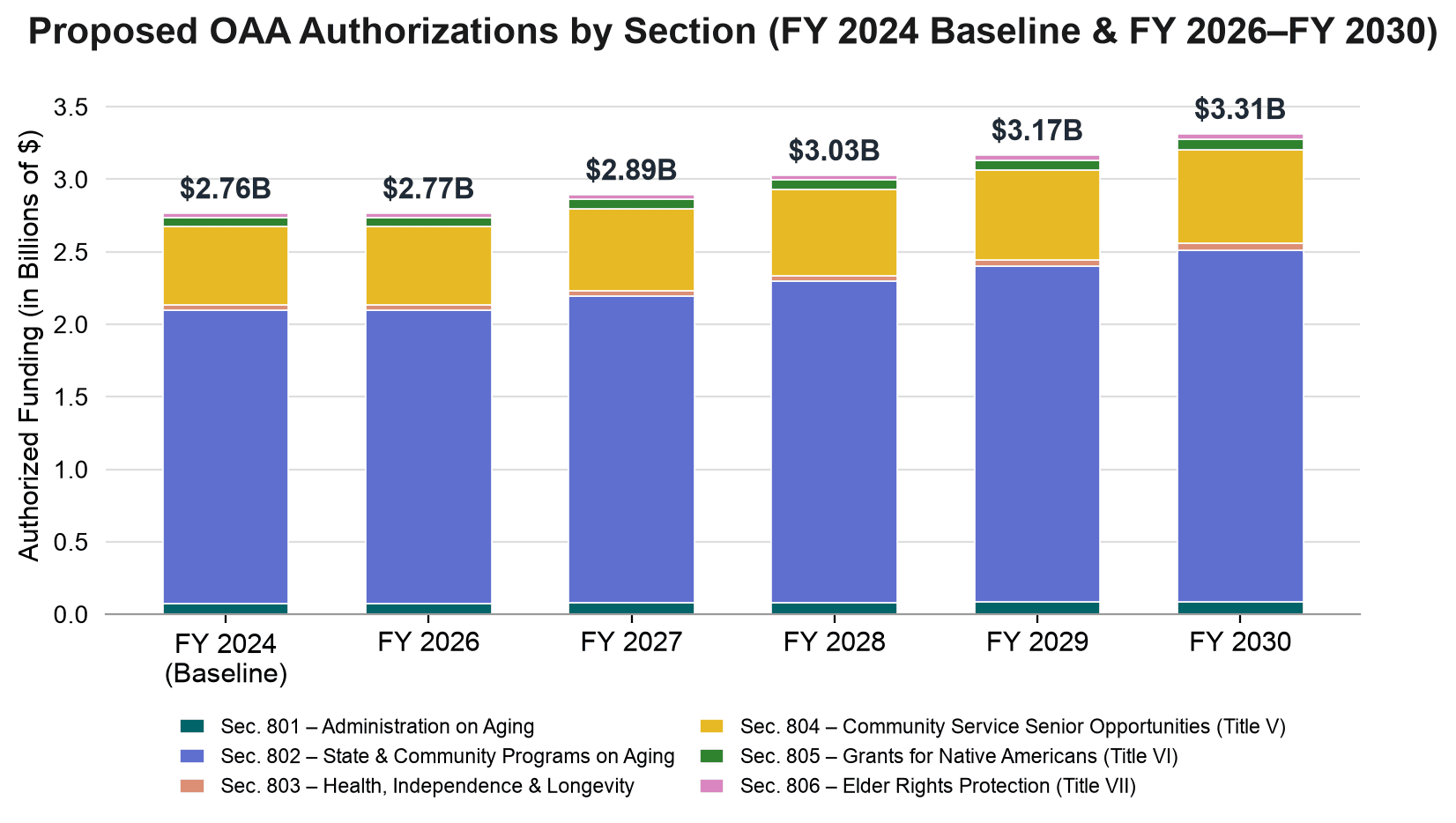
Breaking that total down by Title VIII section shows where the money goes: Sec. 802 (Grants for State and Community Programs on Aging) and Sec. 804 (Community Service Senior Opportunities, Title V) together make up the large majority of authorized funding in every year, with Sec. 801, 803, 805, and 806 covering administration, health promotion, tribal programs, and elder rights protection.
Note on “Authorizations” vs. “Appropriations”: It is important to emphasize that S. 2120 is an authorization bill. While it establishes these higher funding targets in federal law, it does not actually spend the money. Congress must still approve these levels through the annual federal appropriations process to make the physical funding available to states and local agencies.
What Happens Next?
Having just passed the Senate, S. 2120 is being formally received by the House. It will be referred to the House Committee on Education and the Workforce, which holds primary jurisdiction over the Older Americans Act. Advocacy groups, ranging from USAging to local elder-care federations, are launching campaigns to inform House leadership to fast-track the Senate’s bipartisan consensus bill.
How You Can Help
With the Senate passing the bill unanimously, advocacy groups are emphasizing that grassroots pressure on the House of Representatives is key to pushing S. 2120 across the finish line. Because the bill has a high risk of getting bogged down in budget debates or partisan additions, immediate, targeted contact can be incredibly effective.
If you or people in your network want to help get this reauthorization passed, here are the most effective ways to take action:
1. Directly Target the House Committee on Education and the Workforce
While calling your local representative is always a good idea, the real bottleneck right now is the committee that holds the keys to the bill.
- The Action: Check if your representative sits on the House Committee on Education and the Workforce. If they do, your voice carries triple the weight.
- The Message: Urge them to “support and fast-track S. 2120, the Older Americans Act Reauthorization Act, as passed by the Senate without introducing controversial amendments that could stall the bill.”
2. Personalize the Message with Local Data
Form letters are easily ignored, but local impact data gets staffers’ attention immediately.
- The Action: When you write or call, mention specific local programs. For example: “Our local Meals on Wheels program in [Your Town/City] has a waiting list,” or “The family caregivers in our district rely heavily on the respite care funded by Title III.”
- Why it works: Congressional staffers track how many constituents call about specific, localized issues to brief their representatives.
3. Coordinate with Local Area Agencies on Aging (AAAs)
Local aging services are already organized and have existing advocacy frameworks.
- The Action: Contact your local Area Agency on Aging (AAA) or Title VI Native American aging program. They often have customized template letters, specific statistics for your congressional district, and coordinated “Call-In Days” that you can join to amplify your impact.
- Where to find them: You can use the Eldercare Locator (a service actually funded by the OAA) to find your local AAA.
4. Engage Coalitions
Several major national organizations have pre-built advocacy dashboards where you can enter your zip code and automatically send a pre-formatted, yet customizable, letter directly to your representative. You can utilize the action centers of:
- ADvancing States
- USAging (the national association representing local Area Agencies on Aging)
- Meals on Wheels America
- NCOA (National Council on Aging)
- AARP
The Power of the Senate’s 100-0 Vote: When contacting a House office, always point out that S. 2120 passed the Senate with unanimous, 100-0 bipartisan support. In a highly polarized political environment, reminding representatives that both Bernie Sanders and Bill Cassidy co-authored and supported this exact bill is a powerful argument against letting it get caught in party gridlock.